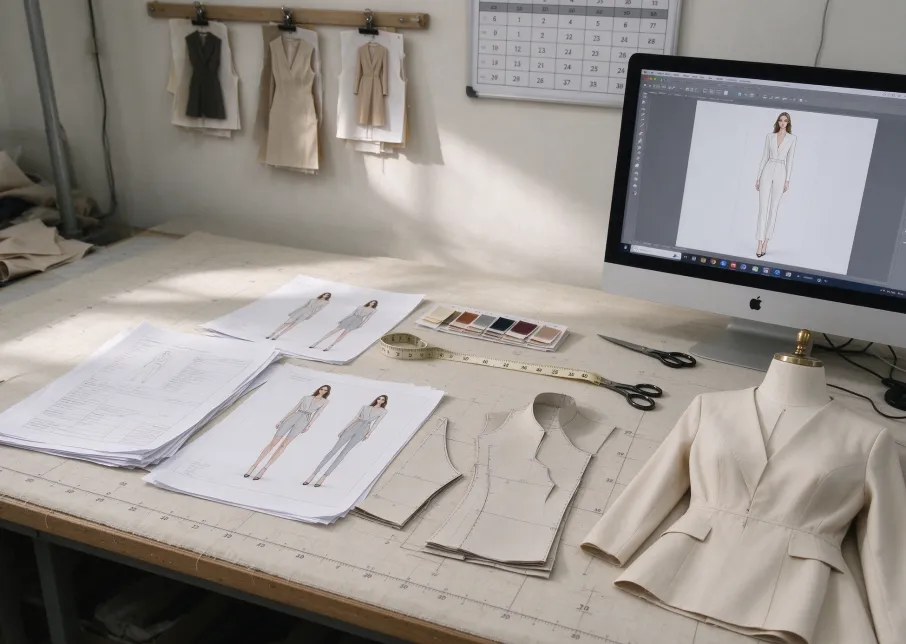


Every successful custom apparel production run starts with a clear, detailed clothing tech pack. A tech pack is the master document that tells your factory exactly how to build your garment. It removes guesswork, reduces sample mistakes, controls quality and protects you from receiving finished products that do not match your vision. Many new designers rely only on sketches and reference photos, and this almost always causes miscommunication, delayed samples and costly bulk errors. Learning how to create a tech pack for a clothing manufacturer is an essential skill if you want to run a smooth clothing production process, whether you are working on small-batch sustainable basics or complex custom styles.
The first core part of garment tech pack requirements for bulk production is technical flat sketches. These are clean, line-drawn front and back views of your garment, not artistic fashion illustrations. Flats show every construction detail: seam placement, pocket shape, collar style, cuff design, logo location, stitch types and zipper paths. Every visual detail you want the factory to replicate must be marked on the flat sketch. If you plan to add custom embroidery, woven labels or hangtags, mark their exact position and size directly on the drawing. Your sketches should be simple, black and white, and easy for pattern makers and sewing teams to understand.
Next is the measurement spec sheet, which is often the most important section of the entire tech pack. This chart lists every measurement point of the garment, including chest, length, shoulder, sleeve, waist, hip, inseam and hem width, plus tolerance notes. Tolerance tells the factory how much plus or minus variation is acceptable during production. For example, a tolerance of ±0.5 inches means the finished garment length can vary slightly within that range. Without clear measurements and tolerances, your fit will be inconsistent across samples and bulk orders. You should also note whether measurements are taken flat, relaxed, or stretched, especially for knit stretch fabrics.
Your tech pack also needs full fabric and trim specifications. Include fabric name, composition, weight, width, weave type, color name, color reference (Pantone number or physical color swatch), and any required certifications such as GOTS or OEKOTEX. For trims, list buttons, zippers, drawcords, labels, care tags, embroidery and thread colors. Write down the supplier part numbers if you are sourcing trims yourself. If you are using custom artwork like your AWOKI logo, attach the production-ready vector SVG file and note requirements such as embroidery size, stitch type and letter spacing. This is where you avoid issues like the factory resizing your logo incorrectly or using the wrong thread color.
Construction notes and finishing instructions are another key section. Here you describe stitching type, seam finish, washing method, pressing requirements and packaging rules. For example, you may specify a 4-thread overlock seam, enzyme wash for denim, or that each garment must be folded with a hangtag and polybag. If you have special quality standards, list them here too. You can also add reference photos, inspiration images and notes about the intended hand feel and drape of the fabric.
Many new brand owners search for an apparel tech pack template for manufacturers to speed up the process. A good template organizes all these sections: flats, measurement chart, fabric & trim specs, artwork, construction notes, color references and approval sign-off pages. You can build it in Excel, Google Sheets, Figma or Adobe Illustrator. However, a template is only useful if you fill it out completely. Leaving blank fields or vague descriptions defeats the purpose of the tech pack.
Once your tech pack is finished, send it to your manufacturer together with physical swatches and reference samples. Ask them to confirm they understand all requirements before starting pattern making or sampling. Use the tech pack as the point of reference for every sample revision. When the factory sends a sample back, compare it against the spec sheet and mark deviations clearly. After you sign off on the final sample, the tech pack plus approved sample becomes the golden standard for bulk production.
A strong tech pack is your best tool to align expectations with your supplier. It saves time, reduces sample rounds and makes quality control much easier. Mastering how to create a tech pack for a clothing manufacturer will help you run a professional, reliable clothing brand, whether you are ordering small low-MOQ runs or scaling up into larger production.